

KPIT writes the code in tomorrow’s cars. What did a KPIT SIP actually do?
The company: KPIT Technologies writes the software that goes inside cars: the code that runs electric and hybrid powertrains, driver assistance and autonomous driving, and connected cars that get new features as updates. Its customers are global carmakers, and most of its revenue comes from Europe. That puts it on most lists of Indian stocks riding AI and the shift to the software-defined vehicle.
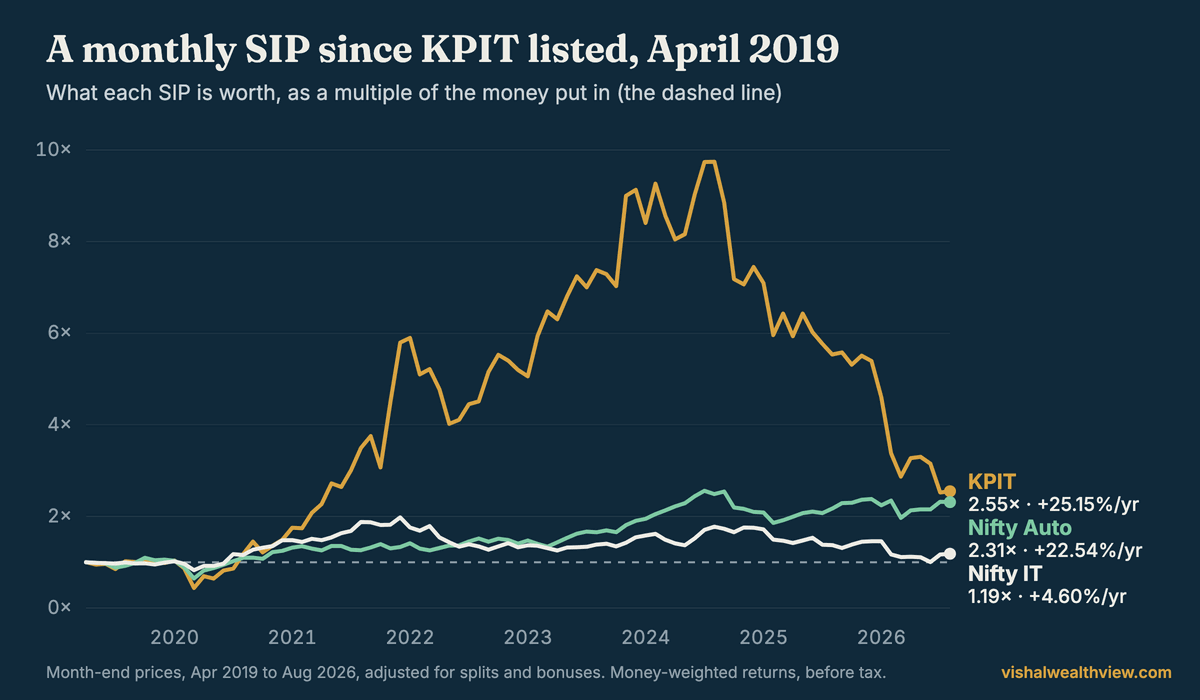
A good story is not the same as a good holding. So we asked what a plain monthly SIP in KPIT actually did, from its first month on the NSE in April 2019 to August 2026, against the carmakers it sells to (Nifty Auto), Indian IT (Nifty IT) and the Nifty 50.
What KPIT does
- Software for cars, not cars: KPIT does not build vehicles. It writes and tests the software carmakers put in them, from battery and motor control to the code behind driver assistance.
- Where AI comes in: perception and autonomous-driving software, and the platforms that keep a connected car updated after it is sold.
- Who pays: global automakers and their suppliers. Europe is its largest market, followed by the Americas.
- How it listed: today’s KPIT Technologies came out of a 2019 restructuring of the old KPIT that also created Birlasoft, and its shares started trading in April 2019.
Where the money comes from, and where it goes
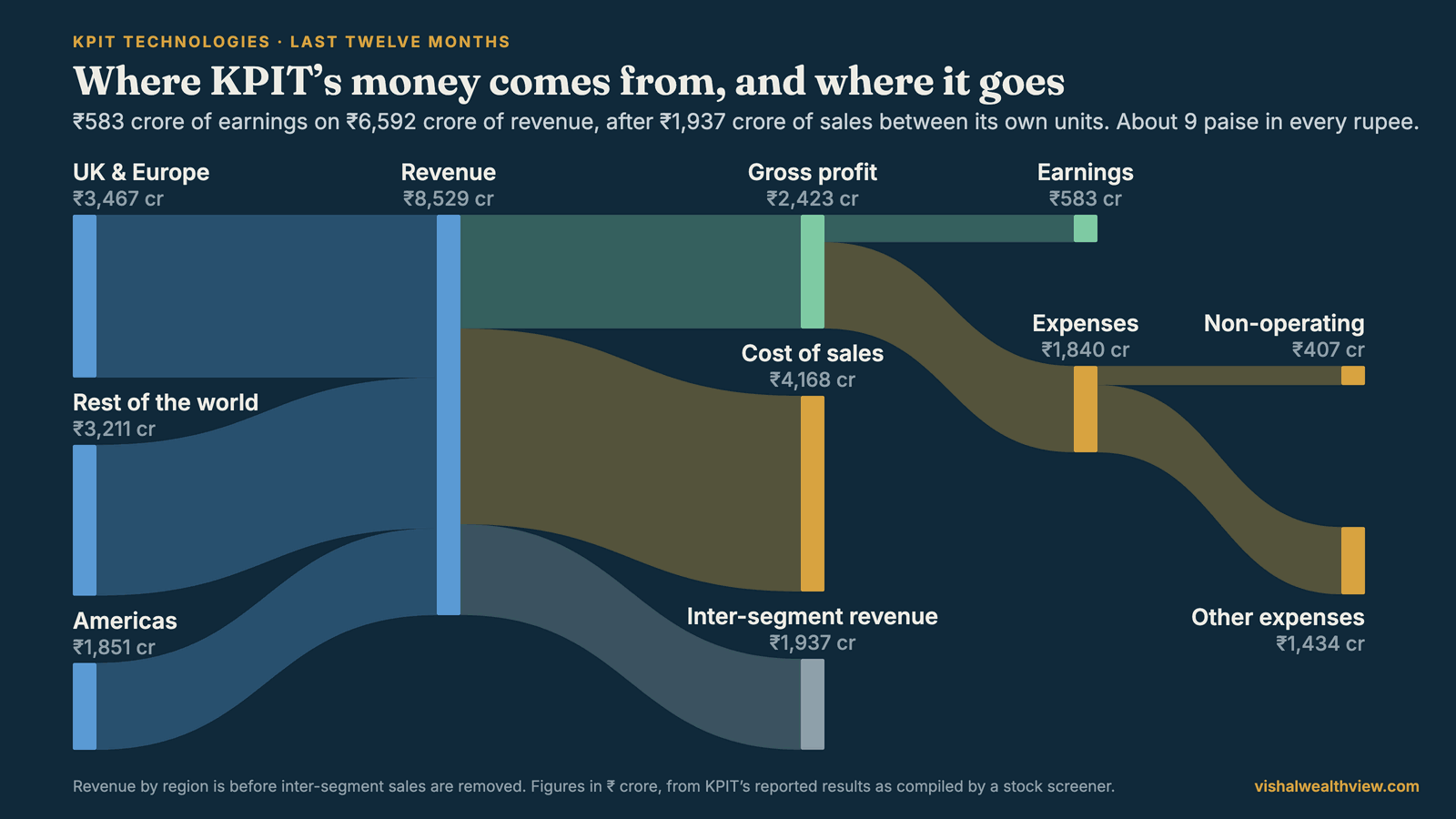
Over the last twelve months KPIT booked ₹6,592 crore of revenue once sales between its own units are taken out. UK & Europe is the largest region, ahead of the rest of the world and the Americas. Cost of sales took ₹4,168 crore, leaving ₹2,423 crore of gross profit, and after ₹1,840 crore of other expenses, ₹583 crore of earnings: about 9 paise in every rupee of revenue.
That is the business the market is pricing. The SIP numbers below show what it has been like to own it.
A KPIT SIP since listing
A fixed amount invested at each month-end from April 2019 to August 2026, 89 months. Returns are money-weighted (XIRR) and before tax.
| Since Apr 2019 | A year | Worth | Worst fall |
|---|---|---|---|
| KPIT | 25.15% | 2.55× | 67.0% |
| Nifty Auto | 22.54% | 2.31× | 44.0% |
| Tata Elxsi | 10.58% | 1.48× | 60.7% |
| Nifty 50 | 9.64% | 1.43× | 29.3% |
| Nifty IT | 4.60% | 1.19× | 39.3% |
"Worth" is the SIP’s value divided by the money put in: 2.55× means every ₹100 invested is now worth about ₹255. Tata Elxsi, another Indian company that writes software for carmakers, is there for comparison.
The part the return hides
The share went from about ₹109 at the end of its first month to a month-end high of ₹1,815 in August 2024. At that point the SIP was worth 9.75× the money put in. Two years later the share was ₹609, 66.4% below that high, and the SIP was worth 2.55×. Its worst fall along the way was 67.0%.
The 25.15% a year is real, but it belongs to people who started early and held through a fall of two-thirds. It is also a number that could keep moving: on 29 September 2026 the share traded near ₹500.
Starting at the high
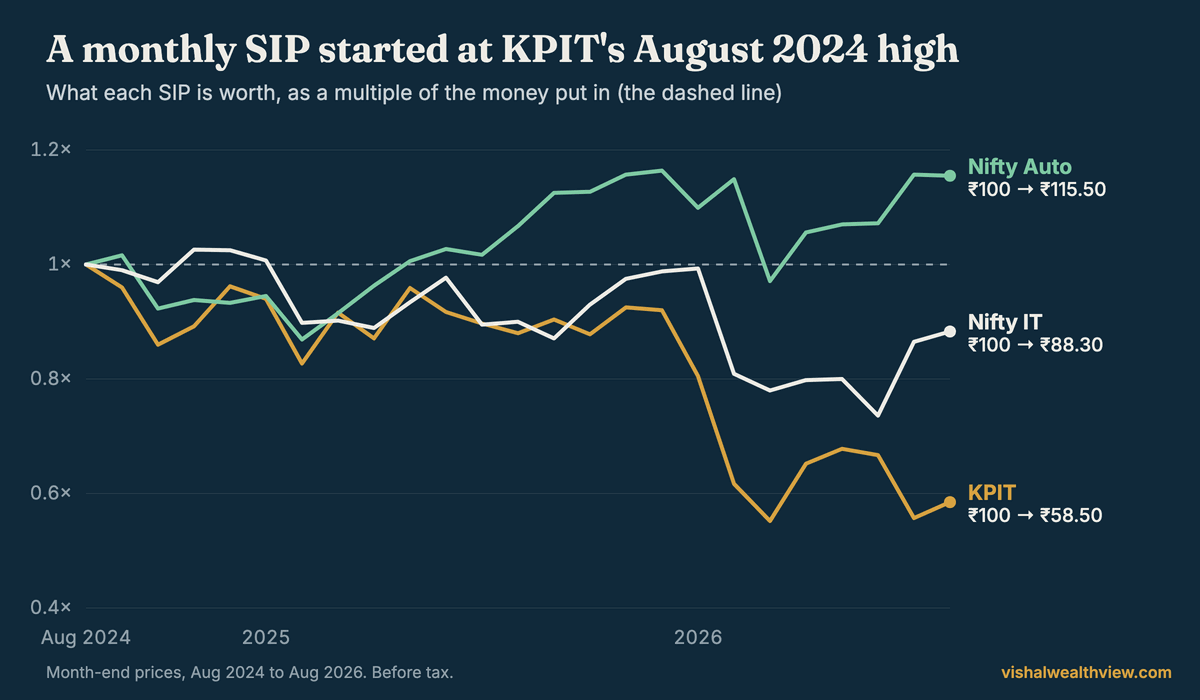
A SIP started in August 2024, when the story was loudest, was worth ₹58.50 for every ₹100 put in by August 2026. The same SIP in Nifty IT was worth ₹88.30, and in Nifty Auto ₹115.50.
The carmakers did almost as well, with less pain
A SIP in Nifty Auto since April 2019 made 22.54% a year, close to KPIT’s 25.15%. Its worst fall was 44.0% rather than 67.0%, and it ended August 2026 at a new high. Indian IT as a whole did far worse: Nifty IT made 4.60% a year and sits 28.0% below its December 2024 high.
What to take from this
Software-defined cars may well be where the industry is going. That tells you about demand. It does not tell you what price you are paying for one company’s shares, or whether you could sit through a fall of two-thirds. KPIT shows both sides: an early SIP did better than the index, and a late one is sitting on a loss.
Before acting on a story, check it on real data. Run the same SIP in the Strategy Lab, move the start date, or add a rule that moves to cash in a deep fall and see whether it would have helped.
Questions people ask
What does KPIT Technologies do?
KPIT Technologies, based in Pune, writes software for carmakers: code for electric and hybrid powertrains, driver assistance and autonomous driving, connected cars and software-defined vehicles. Its clients are global automakers, and Europe is its largest market.
What did a KPIT SIP return?
A monthly SIP in KPIT Technologies from its April 2019 listing to August 2026 returned 25.15% a year, before tax, against 22.54% for Nifty Auto, 9.64% for the Nifty 50 and 4.60% for Nifty IT.
How far has KPIT fallen from its high?
KPIT’s month-end share price peaked at ₹1,815 in August 2024 and was ₹609 at the end of August 2026, 66.4% lower. A monthly SIP started at that high was worth ₹58.50 for every ₹100 put in two years later.
How did Nifty Auto compare with KPIT?
Over the same months a Nifty Auto SIP made 22.54% a year, close to KPIT’s 25.15%, with a worst fall of 44.0% instead of 67.0%, and it ended August 2026 at a new high.
How we measured: month-end prices, a fixed amount invested every month from April 2019 (KPIT’s first month on the NSE) to August 2026, returns money-weighted (XIRR) and before tax. KPIT and Tata Elxsi prices are from NSE and adjusted for splits and bonuses; Nifty Auto, Nifty IT and Nifty 50 are read from NSE factsheets and approximate. "Worst fall" is the largest month-end drop from a previous high inside the window. The 29 September 2026 price is a live NSE quote. Revenue, costs and earnings are KPIT’s reported results for the last twelve months, as compiled by a stock screener, converted to crore; revenue by region is before inter-segment sales are removed. Company background: KPIT Technologies. Past returns are not a promise of future returns. Nothing here is a recommendation to buy or sell anything. See the disclaimer.
← All posts