

Mutual fund backtesting: test any Indian fund on its real NAV history
Mutual fund backtesting means running a SIP, or any other way of investing, on a fund’s real past NAVs to see what it would have done: the return, the worst fall, and what the money became. The Strategy Lab does it for any Indian mutual fund with an AMFI NAV, free, in your browser. It also goes a step further than a SIP calculator: it tests 31,080 “sell after a fall, buy back lower” rules on the same fund, so you can see whether timing would have helped.
How to backtest a mutual fund in three steps
- Pick the fund. Open the Strategy Lab, choose the Mutual fund tab and type the fund’s name. Every scheme with an AMFI NAV is searchable.
- Set the SIP. Enter a monthly amount and the months to test. The Lab uses the fund’s real month-end NAVs for that window.
- Read the result. See the SIP’s return a year (XIRR), its worst fall and what the money became, then press Find the best strategy to test 31,080 timing rules on the same fund.
Six funds, backtested
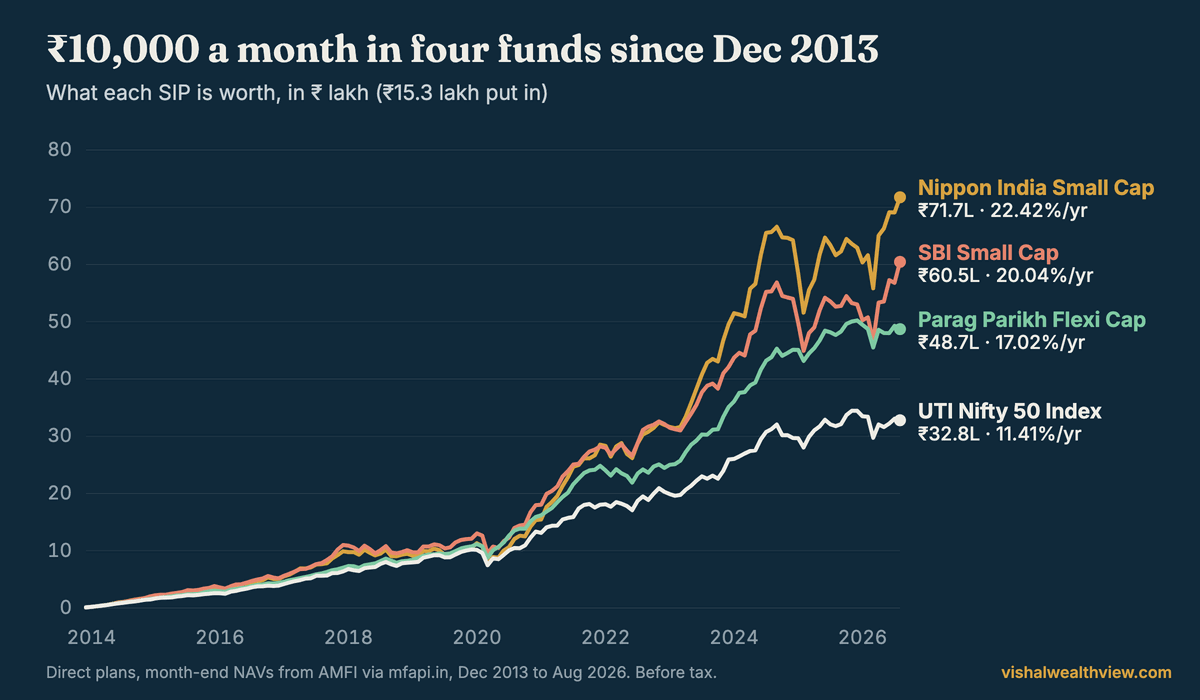
A ₹10,000 monthly SIP in the direct plan of six well-known funds, from December 2013 to August 2026: 153 months, ₹15.3 lakh put in. “Rules that won” is the share of the Lab’s 31,080 timing rules that beat simply continuing the SIP. Tap a fund to open its backtest.
| Fund, SIP since Dec 2013 | A year | Worst fall | Rules that won |
|---|---|---|---|
| UTI Nifty 50 Index Fund | 11.41% | −29.4% | 44.3% |
| Mirae Asset Large Cap | 13.09% | −28.2% | 38.3% |
| HDFC Flexi Cap | 16.85% | −34.3% | 41.6% |
| Parag Parikh Flexi Cap | 17.02% | −23.1% | 47.6% |
| SBI Small Cap | 20.04% | −33.0% | 4.6% |
| Nippon India Small Cap | 22.42% | −41.6% | 10.1% |
What the backtest shows
- The index fund set the bar. UTI Nifty 50 Index Fund returned 11.41% a year. Every active fund in the table beat it over these months, by 1.7 to 11 points a year.
- The highest returns came with the deepest falls. Nippon India Small Cap made 22.42% a year, and its SIP fell 41.6% at the worst point. Parag Parikh Flexi Cap made 17.02% with a worst fall of 23.1%.
- Timing rarely helped, and least on the best performers. On SBI Small Cap only 4.6% of the 31,080 rules beat a plain SIP, and 10.1% on Nippon India Small Cap. On the steadier funds 38% to 48% did, and the winners were only known afterwards.
The takeaway is not which fund to buy. It is that a fund’s past return, its falls and whether any rule would have helped are all checkable before you commit money, on the fund’s own history rather than a category average.
What a mutual fund backtest can and cannot tell you
- It uses what you would have got. NAVs are published after the fund’s expenses, so costs are already in the result. Direct and regular plans have different NAVs; test the one you hold.
- It cannot see the future. Managers, portfolios, fund sizes and fees change. A backtest is a record of the past, not a forecast.
- Hindsight flatters rules. The best timing rule on a fund is only known after the fact. The Lab’s Rolling windows tab shows how often a rule won across every period, which is a fairer test than one lucky start date.
- Tax changes the answer. Every switch sells units, and selling is taxed. With tax switched on, the Lab taxes each lot on both sides of the comparison.
What you can test on a fund
A plain monthly SIP and a one-time lump sum are free. So is the drawdown rule and the 31,080-rule search. Premium adds step-up SIPs, lump sum plus SIP, buy-the-dip and value averaging, moving-average and crossover rules, and Indian capital-gains tax. To see what a SIP grows to at an assumed return instead, use the SIP calculator with inflation and tax.
Questions people ask
How do I backtest a mutual fund in India?
Open the Strategy Lab, choose the Mutual fund tab and search for the fund by name. Set a monthly SIP and a start and end month. The Lab runs the SIP on the fund’s real month-end NAVs and shows the return (XIRR), the worst fall and what the money became. Find the best strategy then tests 31,080 sell-and-buy-back rules on the same fund.
Is mutual fund backtesting free?
Yes. The SIP backtest, the worst fall and the 31,080-rule search are free. The Lab’s default fund needs no account; a free account can test any 3 funds or indices a day. Taxes, other SIP types and moving-average rules are part of Premium.
What data does the mutual fund backtest use?
The NAV every Indian fund publishes through AMFI, fetched from mfapi.in and reduced to the last NAV of each month. NAVs are after the fund’s expenses, so costs are already in the result. Direct and regular plans are separate schemes with different NAVs.
Can I backtest a mutual fund SIP after tax?
Yes, in Premium: the Lab applies Indian capital-gains tax lot by lot (LTCG at 12.5% above ₹1.25 lakh a year, STCG at 20%) to both the plain SIP and any timing rule, so the comparison is after tax on both sides.
Does a good backtest mean the fund will do well?
No. A backtest shows what a fund’s past NAVs would have done to a SIP, not what the fund will do. Fund managers, portfolios and fees change. On the six funds below, the best timing rule was only knowable in hindsight.
How we measured: direct-plan NAVs published through AMFI, fetched from mfapi.in and reduced to the last NAV of each month, December 2013 to August 2026. A fixed ₹10,000 invested at each month-end; returns are money-weighted (XIRR) and before tax. “Worst fall” is the largest month-end drop of the SIP’s value from a previous high. “Rules that won”: sell trigger 5–50%, buy-back 20–80% and at least 5 points deeper, share moved 25/50/75/100%, re-entry 0–50%, 2.5% steps, money moved out earning 6% a year. The funds are examples, not recommendations; past returns are not a promise of future returns. See the disclaimer.
← All free tools