

Nifty is more than 12% off its peak. Does buying the dip actually pay?
On 28 September the Nifty 50 closed at 22,780, about 14% below its 52-week high of 26,373. Falls like this bring out the oldest idea in investing: buy the dip. Keep your SIP going, and put in extra while prices are down.
So we tested it on 30 years of Nifty 50 data. A ₹10,000 monthly SIP, doubled to ₹20,000 in any month the Nifty ended 12% or more below its peak, against the same SIP kept plain. Neither ever sells. We ran it from January 1996 to August 2026, and over every 5, 10 and 15-year stretch inside that.
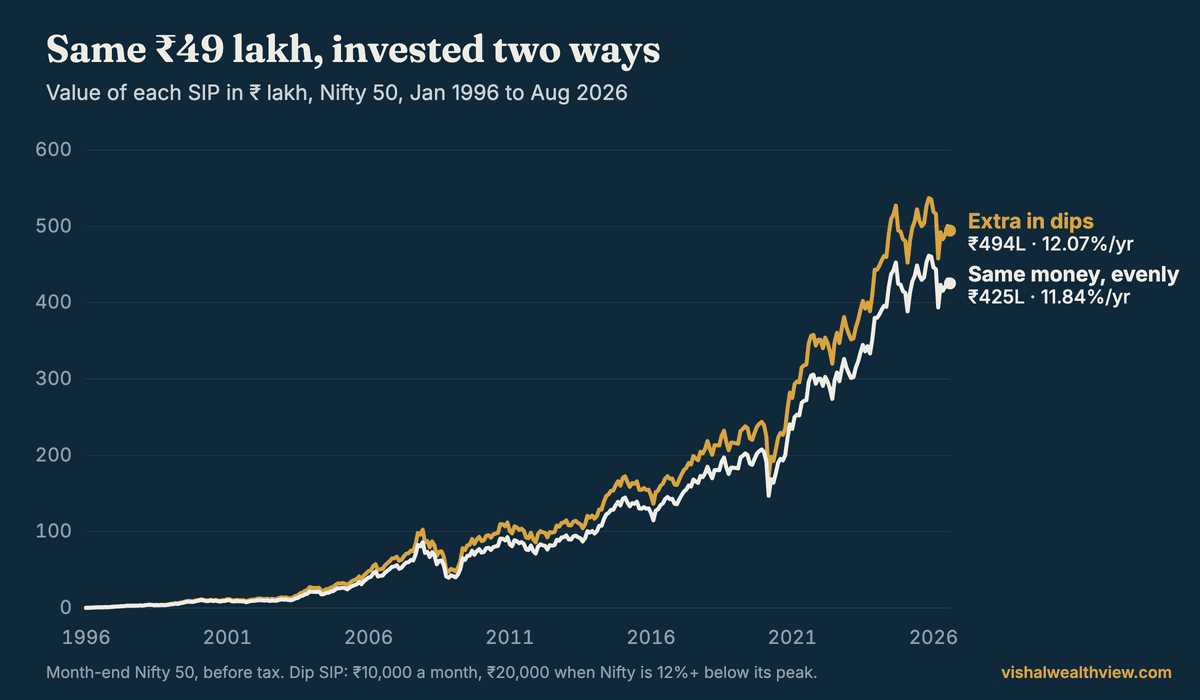
The result, over 30 years
The dip SIP made 12.07% a year, money-weighted and before tax, against 11.84% for the plain SIP. Per rupee, that is a small edge: 0.23 percentage points a year.
But the dip SIP also put more money in: ₹48.9 lakh against ₹36.8 lakh. The fair test is the same total money. A plain SIP of ₹13,288 a month also puts in ₹48.9 lakh; it grew to ₹4.25 crore. The dip SIP, with its extra timed to the falls, grew to ₹4.94 crore, 16.2% more.
| Jan 1996 to Aug 2026 | A year | Put in | Worth |
|---|---|---|---|
| Plain SIP, ₹10,000 | 11.84% | ₹36.8 L | ₹3.20 Cr |
| Plain SIP, same money | 11.84% | ₹48.9 L | ₹4.25 Cr |
| Buy the dip | 12.07% | ₹48.9 L | ₹4.94 Cr |
It usually helped, a little
One 30-year result can be luck, so we ran every start month. The dip SIP beat the plain SIP in 225 of 249 ten-year periods (90%), 297 of 309 five-year periods (96%) and 169 of 189 fifteen-year periods (89%). The median edge was +0.71 points a year over five years, +0.25 over ten and +0.14 over fifteen: small, but on the right side about nine times in ten.
Waiting for deeper falls, or buying more, helped slightly more. Tripling the SIP at a 20% fall made 12.31% a year over the full 30 years, against 12.07% for doubling at 12%.
The catch: dips can last years
The Nifty was 12% or more below its peak in 121 of 368 months, a third of the time. Most dips passed within a few months, but two did not. From July 2000 to September 2003 the rule doubled the SIP for 39 months in a row, and from January 2008 to July 2010 for 31. Anyone following it needed that extra money set aside for years, not weeks.
A 12% fall is also rarely the bottom. Of the 9 earlier times since 1996 that the Nifty fell 12% below a peak, it went on to fall 20% or more in 7, and 55% in 2008. Buying the dip worked because the extra buying kept going through the deeper falls, not because 12% was the low.
What to take from this
History is on the side of adding more when the index is down, as long as the plain SIP never stops and the extra money is genuinely spare. The gain is modest per rupee; it is timing your extra money, not a way to beat the market by a lot. And it is past data on one index, not a promise.
Run it yourself in the Strategy Lab: change the fall that triggers it, how much extra goes in, and the start date.
Questions people ask
Does buying the dip work on the Nifty 50?
In our backtest from January 1996 to August 2026, doubling a monthly SIP whenever the Nifty 50 was 12% or more below its peak beat a plain SIP in 225 of 249 ten-year periods (90%). The edge is small, a median 0.25 percentage points a year, but steady.
How much extra return does buying the dip give?
Over the full 30 years it made 12.07% a year against 11.84% for a plain SIP, money-weighted and before tax. With the same total money, ₹49 lakh, it grew to ₹4.94 crore against ₹4.25 crore spread evenly: 16.2% more.
What is the risk of buying the dip?
Dips can last years. The Nifty was 12% or more below its peak in 121 of 368 months, and from July 2000 to September 2003 the rule would have doubled the SIP for 39 months in a row. Without that extra cash set aside, the strategy breaks.
Is a 12% fall the bottom?
Not usually. After 7 of the 9 earlier times since 1996 that the Nifty fell 12% below a peak, it went on to fall 20% or more.
How we measured: Nifty 50 official month-end closes from NSE Indices, January 1996 to August 2026. A fixed ₹10,000 invested at each month-end; the dip SIP invests ₹20,000 in any month the index ends more than 12% below its highest month-end so far. Neither SIP ever sells. Returns are money-weighted (XIRR) and before tax; rolling periods start in every month. The 28 September close and 52-week high are from NSE. Past returns are not a promise of future returns. Nothing here is a recommendation to buy or sell anything. See the disclaimer.
← All posts