

India’s wind sector is on track for 100 GW by 2030. What did a Suzlon SIP actually do?
The news: Suzlon Energy co-founder Girish Tanti told The Economic Times that India’s wind industry can see about 85 GW of capacity that could be commissioned before 2030, counting bids already announced and projects being built. With more bids expected, he says the sector is broadly on track for the government’s 100 GW wind target.
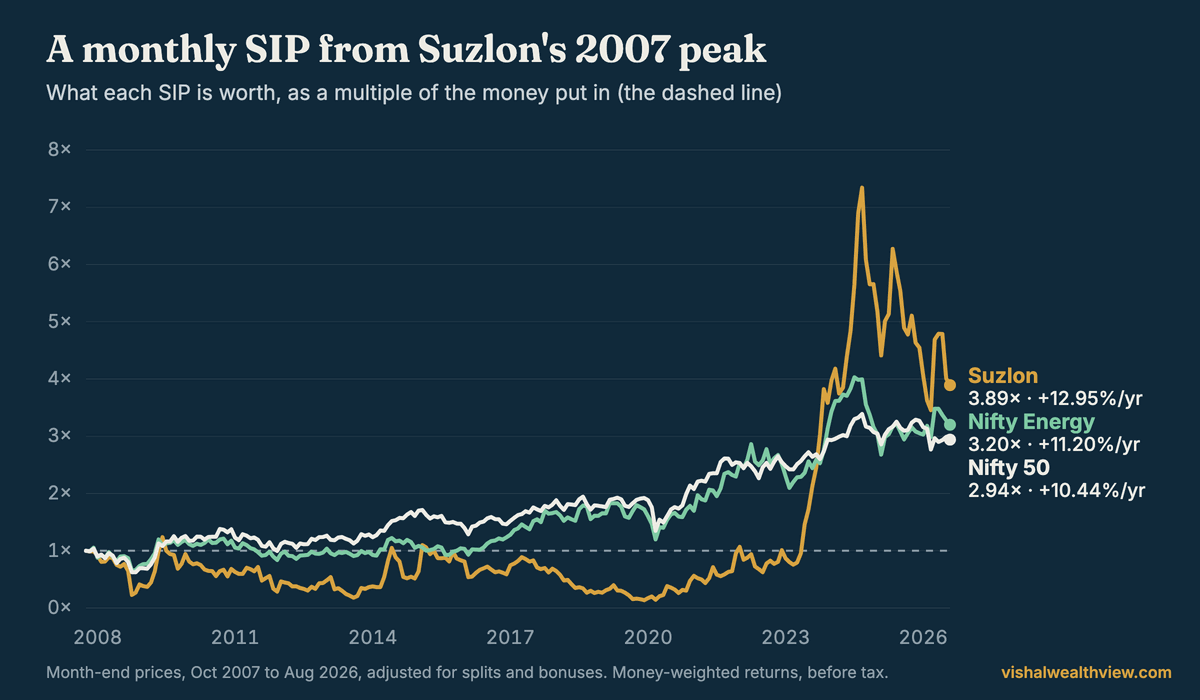
Suzlon is the stock most Indian investors reach for when wind is in the news. So we asked a harder question than "is the target good news?": what did a plain monthly SIP in Suzlon actually do? We started it at the worst possible moment, Suzlon’s all-time high in October 2007, and ran it to August 2026 against Nifty Energy and the Nifty 50.
What Girish Tanti said
- 85 GW in sight: bids announced, projects in development and projects under construction add up to about 85 GW that could be commissioned before 2030.
- On track for 100 GW: with five years left and more bids to come, he expects the industry to largely meet the target.
- Risk one, the grid: transmission was built for conventional power plants and has not kept pace, so some renewable power is already being curtailed. He expects the gap to close over about three years.
- Risk two, the bidding pipeline: several projects have been bid out but their power purchase agreements are not yet signed.
- The next goal: he wants planning to aim for 400 GW of wind by 2047. In his words, "As an industry we are ready."
A Suzlon SIP from its 2007 peak
A fixed amount invested at each month-end from October 2007 to August 2026, 227 months. Returns are money-weighted (XIRR) and before tax.
| Since Oct 2007 | A year | Worth | Worst fall |
|---|---|---|---|
| Suzlon | 12.95% | 3.89× | 99.5% |
| Nifty Energy | 11.20% | 3.20× | 51.8% |
| Nifty 50 | 10.44% | 2.94× | 55.1% |
"Worth" is the SIP’s value divided by the money put in: 3.89× means every ₹100 invested is now worth about ₹389.
The part the return hides
On the final number, Suzlon wins. On the experience of holding it, it is a different story. The SIP went under water in November 2007 and spent 180 of the next 227 months worth less than the money put in. It only got above that line for good in mid-2023, more than 15 years in.
At the low, in December 2019, every ₹100 put in was worth ₹13.60. Then the stock re-rated: by September 2024 the same SIP was worth 7.34× the money put in. It has since given back almost half, to 3.89×, and the share price is still 89% below its 2007 high.
Very few people keep a SIP running through fifteen years of losses. The 12.95% belongs to the ones who did.
The index route: almost the same return, half the fall
A SIP in Nifty Energy over the same months made 11.20% a year, and its worst fall was 51.8% rather than 99.5%. The Nifty 50 made 10.44% with a 55.1% worst fall. The Nifty 50 SIP spent 18 of those 227 months below the money put in, and Nifty Energy 52, against Suzlon’s 180.
What to take from this
A sector target tells you where demand is heading. It does not tell you what one company’s shares will do, what price you are paying, or whether you could sit through the falls. Suzlon shows both sides: the story came good in the end, but the path would have broken most investors.
Before acting on a headline, check it on real data. Run the same SIP in the Strategy Lab, move the start date, or add a rule that moves to cash in a deep fall and see whether it would have helped.
Questions people ask
Will India reach 100 GW of wind power by 2030?
Suzlon co-founder Girish Tanti says the industry has visibility of about 85 GW that could be commissioned before 2030 and is broadly on track for 100 GW, with grid readiness and unsigned power purchase agreements as the main risks.
What did a Suzlon SIP return?
A monthly SIP started at Suzlon’s October 2007 peak returned 12.95% a year to August 2026, before tax, against 11.20% for Nifty Energy and 10.44% for the Nifty 50.
How long was a Suzlon SIP under water?
It was worth less than the money put in for 180 of 227 months, from November 2007 until mid-2023. At the December 2019 low, every ₹100 invested was worth ₹13.60.
How did Nifty Energy compare with Suzlon?
Over the same months a Nifty Energy SIP made 11.20% a year, close to Suzlon’s 12.95%, with a worst fall of 51.8% instead of 99.5%.
How we measured: month-end prices, a fixed amount invested every month from October 2007 to August 2026, returns money-weighted (XIRR) and before tax. Suzlon prices are from NSE and adjusted for splits and bonuses; Nifty Energy and Nifty 50 are read from NSE factsheets and approximate. "Worst fall" is the largest month-end drop from a previous high inside the window. Source for the news: The Economic Times, which notes that its reporter travelled on Suzlon’s invitation. Past returns are not a promise of future returns. Nothing here is a recommendation to buy or sell anything. See the disclaimer.
← All posts