

A Bank Nifty timing rule beat holding by 2.6% a year since 2024. How often does it?
Bank Nifty has had a rough year: a sharp fall into March, a recovery into the summer, and another slide through September. A simple moving-average rule handled it well. It stepped aside before two of the falls and bought back in between.
Put ₹10 lakh into Bank Nifty in March 2024 with that rule, and it was worth ₹13.02 lakh by August 2026, against ₹12.31 lakh for just holding. The obvious next question is the one most backtests skip: how often does this rule actually win?
The rule
Stay in Bank Nifty while its 10-month average is above its 11-month average (roughly the 200-day and 225-day averages). When the 10-month closes below the 11-month at a month-end, move everything to a liquid fund. Buy back when it closes above again. The rule only acts at a month’s close, never in the middle of a month.
The last twelve months, trade by trade
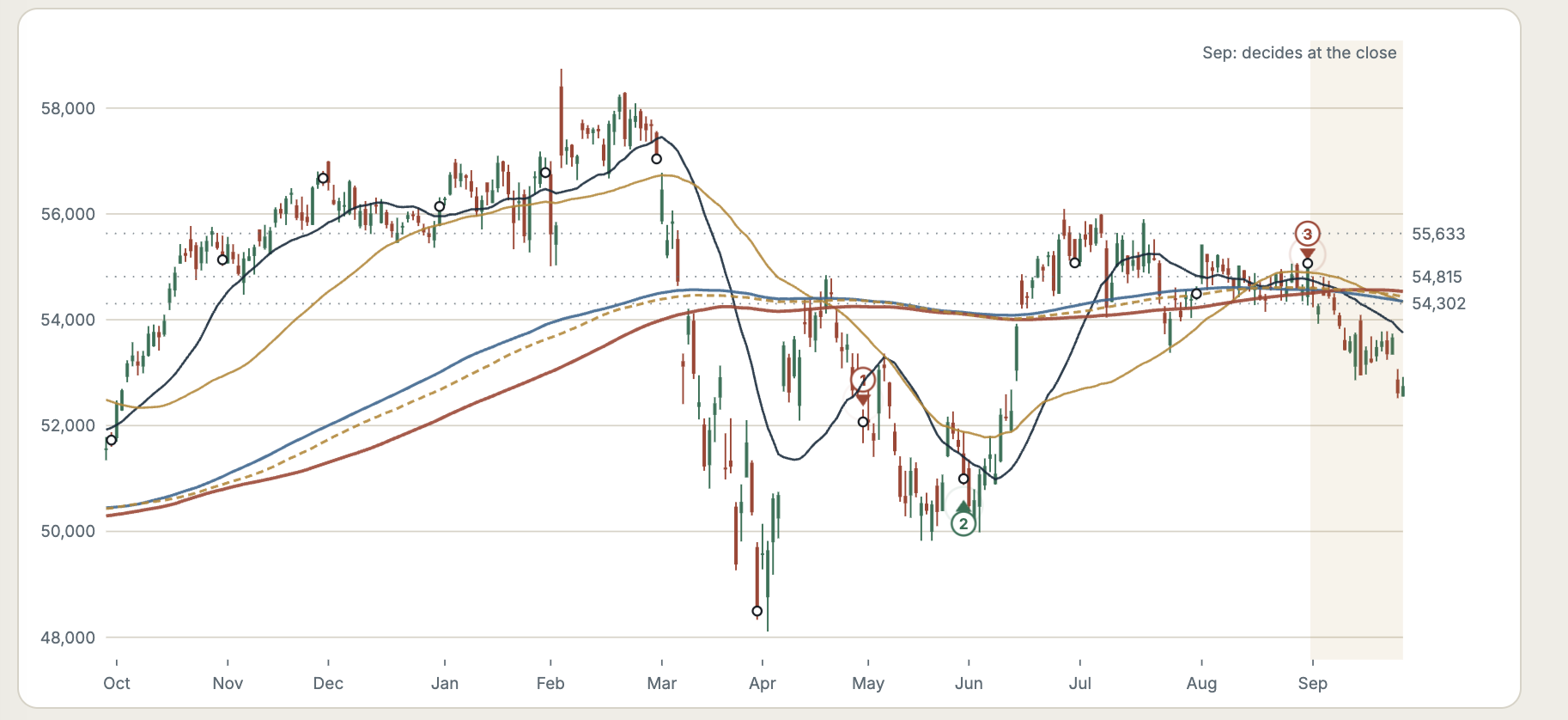
| Close | Action | Level | Result |
|---|---|---|---|
| 30 Apr | Out | 54,863 | Saved 1.1% |
| 29 May | Back in | 54,239 | Made 7.0% |
| 31 Aug | Out | 58,025 | Saved 6.1%* |
All three are 2026 month-end closes. *So far: the rule is still in cash, and September decides at its close.
Over the full window from March 2024 the rule traded four times and sat in cash for 4 of 30 months. Its worst fall was the same 16.9% as holding, since both were invested through the March 2026 drop; the gain came from dodging the smaller moves either side.
The long test: 1 time in 6
One good window proves little. So we ran the same trade, ₹10 lakh held for 30 months with this rule, from every start month since January 2001: 279 separate periods. The rule beat simply holding in 47 of them, 17%.
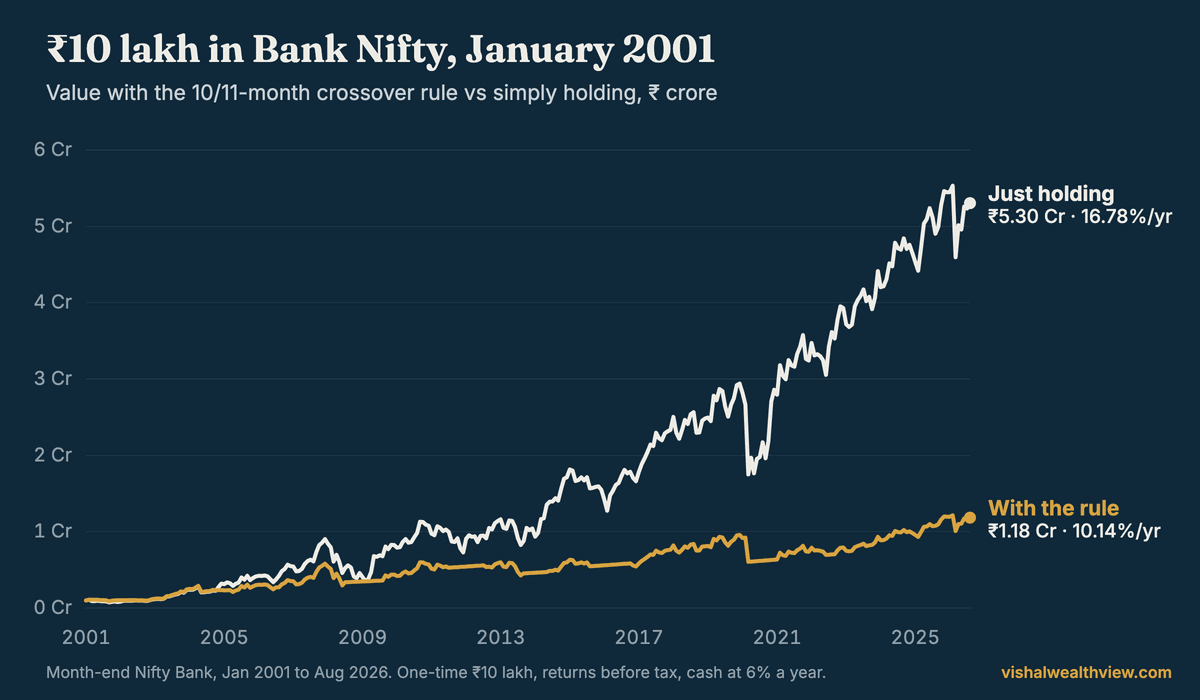
Held from January 2001, the rule made 10.14% a year against 16.78%. It did cut the worst fall, 49.0% against 60.5%, but it paid for that protection many times over by missing recoveries. A crossover like this sells after a fall has started and buys after a recovery has started, so in a market that turns quickly it is late both ways.
What to take from this
A rule that just worked is the easiest thing in investing to believe in, and the last two years of Bank Nifty make this one look sharp. The long record says it usually does not pay. That does not make it useless: someone who values a smaller worst fall might accept the cost. But it should be a choice made with the long numbers in front of you, not the last year’s.
You can open this exact backtest in the Strategy Lab, then move the window back to 2001, change the averages, or compare it with every other rule on the same data.
Questions people ask
Does a moving-average crossover work on Bank Nifty?
Recently, yes: a 10-month against 11-month crossover made 11.54% a year from March 2024 to August 2026 against 8.98% for holding. Over the long run, no: across 279 thirty-month periods since 2001 it beat holding only 47 times.
What did the rule do in 2026?
It stepped aside at the 30 April close at 54,863, re-entered at the 29 May close at 54,239, and stepped aside again at the 31 August close at 58,025.
Is the 200-day moving average a good exit signal for Bank Nifty?
The 10-month average is roughly the 200-day. Used as a crossover exit since 2001, it cut the worst fall from 60.5% to 49.0% but lowered the return from 16.78% to 10.14% a year, because it kept missing the start of recoveries.
How much would ₹10 lakh in Bank Nifty have grown since 2001?
Held from January 2001 to August 2026, ₹10 lakh grew to about ₹5.30 crore, 16.78% a year before tax. With the moving-average rule it grew to about ₹1.18 crore.
How we measured: Nifty Bank official month-end closes from NSE Indices, a one-time ₹10 lakh investment, returns before tax, cash in a liquid fund at 6% a year. The rule compares the 10-month and 11-month simple averages of month-end closes and acts only at a month-end, moving 100% in or out. Averages are taken from the real history before each window, so every period has a signal from its first month. Trade prices are the rule’s month-end closes as shown in the Strategy Lab. Past returns are not a promise of future returns. Nothing here is a recommendation to buy or sell anything. See the disclaimer.
← All posts